rss
@rohhy

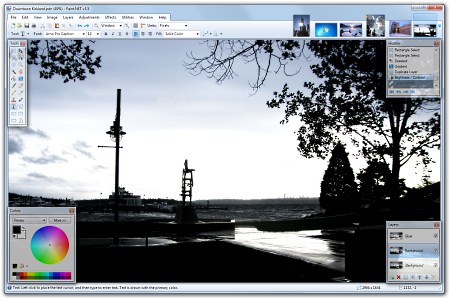
Paint.Net an alternative to Photoshop!

Paint.NET is free image and photo editing software for computers that run Windows. It features an intuitive and innovative user interface with support for layers, unlimited undo, special effects, and a wide variety of useful and powerful tools. An active and growing online community provides friendly help, tutorials, and plugins.


It started development as an undergraduate college senior design project mentored by Microsoft, and is currently being maintained by some of the alumni that originally worked on it. Originally intended as a free replacement for the Microsoft Paint software that comes with Windows, it has grown into a powerful yet simple image and photo editor tool. It has been compared to other digital photo editing software packages such as Adobe® Photoshop®, Corel® Paint Shop Pro®, Microsoft Photo Editor, and The GIMP.

Download it here:
http://www.dotpdn.com/files/Paint.NET.3.5.4.Install.zip

Hacker Psychology

Who is a hacker? A hacker is someone who looks like you and me! but who thinks outside the box. It's someone who discards conventional rules wisdom, and does something else instead. It's someone who think beyond the limits. It's someone who sees a set of rules and wonders what happens if you don't follow them. A hacker is someone who experiments with the limitations of systems. A normal man ask his wife “how many teeth in your mouth?” but a good hacker would have simply counted his wife's teeth without her knowing about it, while she was asleep. A bad hacker might remove some of them, to prove his skill (Well that is next stage of hacking which called cracking!)
Computers are the perfect playground for hackers, as we do all the works and transactions online in this technical age. The best way to defeat your enemy is to know their mindset! So we will discuss how hacker works and what he/she thinks? How they work?
How hacker works? Hacker have several ways to hack information like login and password, it depends who you are, where you are and how the hacker reaches you.
1. Mind Reading This can do anyone! They no need to be specialized for this. A hacker thinks what can their victims can set as password? They start with guesses like date of birth, family names, pet names or address information.
2. Common words What if, I set my password as 12345678? or abcd? These are the most easy to break passwords.
3. Proxy If the hacker is just standing behind you, He will see what you entered from the keypad? This may happen at cybercafé or ATM!
4. Trojan Horse Tools: There are many hacking tools are available on the internet, that can be easily downloaded and used on someone’s machine. {Due to security reason the tool names and how to use is now given here} These software use to extract passwords from cookies saved on local machine!
Key Logger: This is more worst then previous one! This will track entire activity from your keyboard and send the information through email to the hacker. There is also some hardware based key logger that can be fitted before keyboard plug as show below;
Key Logger
5. IP address Hacker can get your IP address and tack back the activity on the IP address by sending some “Trojan horse”. How they get your IP address? Well that’s very easy, If you write comments on my Wordpress blog I’ll have your IP address! {Feel free to write comments at my blog, Coz I’m not a hacker! or interested in doing so!}
6. Try and Try Hackers can program a server to give different passwords to open someone’s account, but after some false try the login screen ask to solve the CAPTCHA CODE that can’t be solved by machine only human’s can solve it {Not so far! now servers also solves CAPTCHA CODE!}
CAPTCHA
The above are some examples only, more can be done by a hacker! After understanding how a hacker hacks some one’s password. we will understand how to make a complex password?
Password complexity A good password is like; 5eR3$1♥x9%#DF (if you able to remember it!)
Keys can be entered from keyboard:
Capital Letters26
Small Letters26
Numerals10
Symbols32
Total Characters94
Suppose you chose 1 letter as you password e.g. “r” so there is maximum number of tries will be 94 {remember this is maximum, minimum could be 1!}. But if you choose 2 letters e.g. “mk”, the number of tries will be 94^2 = 8836 (94x94)
To make a real complex password you have put some special characters like;
CodeKey
9786
9829
9835
There are 65535 symbols that you can put! they can be entered by holding down the Alt key and entering the number from number pad in the right of your keyboard {remember number pad in right of your keyboard, not the above number line on top of QWERTY}
So the above table can be reviewed like this:
Capital Letters26
Small Letters26
Numerals10
Symbols32
Symbols (With Alt)65535
Total65629
Suppose you chose 1 letter as you password e.g. “r” so there is maximum tries now will be 65629!  {but still the minimum is 1 if some get rite guess as the first attempt!!} and think about 2 letters! it will be 65629 x 65629 = 4307165641!! So make the password more complex and hard to guess.

Why they hack?
1. Personal gain Now a days most of hackers gain access to someone’s account or get access to machine and encrypt all files in hard drive, they decrypt your data if you pay them what they want!
2. For fun Some hackers only hack for their own fun, or to prove their skills!
3. Revenge Some time revenge is also a fact to hack some one. As we see often terrorist hacks government websites.
4. Ethical hacking Well ethical hacking is also a part of hacker’s life. Some time to rescue some one or to prevent damage to someone, they have to do hacking which is called ethical hacking.
Hacker targets celebrities to get fame and to be in limelight, as sometime before Britney Spears’ account was hacked!
Note: This article is not to teach hacking or to appreciate it in any manner! this is just to improve your knowledge and to protect you from password hacks! :)
–Rohy

Add anything to MY Computer!

Here is a simple but useful trick to add your favorite software to access from My Computer {now it called ‘Computer’ only! not ‘My Computer’} window, all you have to do is just copy and paste those shortcuts which you like to appear in Computer:

Rohhy

1. Go to following folder:
%userprofile%\AppData\Roaming\Microsoft\Windows\Network Shortcuts
The user %userprofile% is the location like; ‘C:\Users\ABC’ where ‘ABC’ is the user name

So in my case I would open;
image C:
image Users
imageABC
imageAppData
imageRoaming
imageMicrosoft
imageWindows
imageNetwork Shortcuts

2. Copy a shortcut 
For e.g. I’ve copied Calculator from start menu by right clicking on it and selecting ‘Copy’ option.

3. Paste the shortcut in “Network Shortcuts” folder

4. Start ‘Computer’ from start menu and you will see those shortcuts you have added, under ‘Network Location’.

You can add files, folders, and application in this folder! and have direct access to theme through ‘MY Computer’!

-Rohy Chopda

follow me @rohhy

Microsoft confirms 17-year-old Windows bug

Google engineer reveals ancient flaw in all 32-bit versions of Windows


Computerworld - Microsoft late yesterday issued its second advisory of the last week, warning users that a 17-year-old bug in the kernel of all 32-bit versions of Windows could be used by hackers to hijack PCs.
The vulnerability in the Windows Virtual DOS Machine (VDM) subsystem was disclosed Tuesday by Google engineer Tavis Ormandy on the Full Disclosure security mailing list. Coincidentally, Ormandy received credit for reporting the single vulnerability that Microsoft fixed last week on its regular Patch Tuesday.
The VDM subsystem was added to Windows with the July 1993 release of Windows NT, Microsoft's first fully 32-bit operating system. VDM allows Windows NT and later to run DOS and 16-bit Windows software.
Yesterday's advisory spelled out the affected software -- all 32-bit editions of Windows, including Windows 7 -- and told users how to disable VDM as a workaround. Windows' 64-bit versions are not vulnerable to attack.
It was Microsoft's second advisory in seven days; last week, the company posted a warning of a critical flaw in Internet Explorer after Google said its corporate computers had been hacked by Chinese attackers. That bug is to be patched later today.
"An attacker who successfully exploited this vulnerability could run arbitrary code in kernel mode," said the newest advisory. "An attacker could then install programs; view, change, or delete data; or create new accounts with full user rights."
Jerry Bryant, a program manager with the Microsoft Security Response Center (MSRC), said that the company had not seen any actual attacks using the vulnerability, and also downplayed the threat if hackers do exploit the flaw. "To exploit this vulnerability, an attacker must already have valid logon credentials and be able to log on to a system locally, meaning they must already have an account on the system," Bryant said in an e-mail.
Typically, Microsoft ranks this kind of vulnerability -- which it classified as an elevation of privilege flaw -- as "important," the second-highest of the four ratings in its four-step system.
Ormandy said that the vulnerability goes back nearly 17 years to Windows NT 3.1's release, and exists in every version of Windows since. He reported the bug to Microsoft more than seven months ago.
"Regrettably, no official patch is currently available," Ormandy wrote on Full Disclosure Tuesday. "As an effective and easy-to-deploy workaround is available, I have concluded that it is in the best interest of users to go ahead with the publication of this document without an official patch." The workaround Ormandy included in his message was the same as Microsoft's: Edit group policies to block 16-bit applications from running.
Although Ormandy divulged information about the vulnerability, even posted attack code that works on Windows XP, Server 2003, Vista, Server 2008 and Windows 7, Microsoft didn't take him to task in the advisory for prematurely revealing the bug, as it almost always does researchers who spill the beans before a patch is ready. Presumably, Microsoft will issue a fix for the flaw at some point, but as is its practice in security advisories, it didn't promise to do so.

Internet

History and Evolution of Inter-connected Network!

The History
1957 The Cold War!
In 1957, at the heights of the Cold War, the Soviet Union scored one against the United States when it successfully put in place the world’s first artificial satellite, Sputnik I. To up the ante with the Soviets, the US Department of Defense set up a division dedicated to extreme technology research, ARPA (Advanced Research Project Agency), which later fashioned ARPANET. For the first time in history, computers were able to exchange information electronically. From 1957 to till today the Internet is growing more and more..!


Hardware requirements
For Dial-up connection:
1. Modem
2. Phone Cable
3. Pentium or better Computer
DSL Cable/Broad Band:
1. DSL Modem/Hub
Mobile/Wireless Devices:
1. GPRS enabled phone
2. Data cable (to connect with PC)
Infrared or Bluetooth

Software requirements
Microsoft:
Windows Internet Explorer
Other:
Firefox
Opera
Netscape Navigator
Utilities:
Download accelerator+

The Words:
www World Wide Web
FTP File Transfer Protocol
HTTP Hyper Text Transfer Protocol
HTML Hyper Text Markup Language
TCP Transfer Control Protocol
IP Internet Protocol
ISP Internet Service Provider
DNS Domain Name Server
Surfing/Browsing
Web site/Web page
Follow me @rohhy